Showing posts with label olives. Show all posts

Saturday, November 3, 2012

Election Eve Munchies


I want the election to be over. I'm tired of partisanship, attack ads and endless news cycles of pontificating pundits.
I want the election to be over as long as my candidates and propositions win. That's what I meant to say.

If my side needs more time to win the day, so be it. Take all the time you need.

Skin in the game
Every election cycle feels special. The stakes are always high. The choices game changing. The amount of campaign money spent on elections stupefyingly large.

If you are a conservative, you are convinced the moral fabric of the country is on the line. Our economic future is at risk. 

If you are a liberal, you have seen the Ryan budget and the writing is on the wall for all the Progressive advances since Teddy Roosevelt. If you care about social inequality and women's rights, you are bewildered by the seemingly unending attacks that come from Republican candidates.

On Election Night this Tuesday, given the number of key battle ground states and the voting difficulties created by super storm Sandy, conclusive results might not be forthcoming until late in the evening or early morning.

What you're going to eat on Election Night might not be the first thing on your mind, but after you've finished working the phone banks and you've driven the last person to the polls before they close, it's time to head to a TV at home or a friend's and be prepared for the long haul.

If you don't want to cook, have a collection of take-out menus available. That way you are only a phone call, your credit card and 45 minutes away from a table full of pizza, stir fried green beans with beef and salads with seasonal greens and homemade croutons.

On the other hand, if you want home cooked food, here are some easy-to-make favorites that we like to serve when we're watching the Super Bowl, NBA Playoffs and waiting to celebrate the beginning of another year.

Good luck to you and all the candidates you believe in and the propositions you are voting for.


Tapenade with Charred Garlic

A secret weapon in last minute cooking, tapenade brightens any meal either as an appetizer or a condiment. If you use pitted, canned olives, making tapenade will take 10-15 minutes.
 
The taste of your tapenade depends on the quality of the olives.

Serves 6-8

Ingredients

1 can pitted olives, drained weight 6 oz., preferably green or kalamata olives
2-3 tablespoons olive oil
2 garlic cloves with skins
¼ cup Italian parsley, washed, leaves only, roughly chopped
¼ teaspoon pepper flakes (optional)
Black pepper to taste

Directions

Skewer the garlic cloves on the end of a knife or a metal skewer and hold over a gas flame to burn off the outer skins. Let cool, remove any pieces of charred skin and roughly chop the cloves.

In a small blender or food processer, place the drained olives, olive oil, garlic, parsley and pepper flakes. Pulse until the olives are roughly chopped. Taste and adjust the seasoning with the addition of black pepper, sea salt, pepper flakes and olive oil.

Pulse again until the tapenade achieves the desired texture. Personally I like a tapenade that has a rustic look with the olives coarsely chopped rather than puréed.

Refrigerate until ready to use and serve at room temperature.

Variations

 2 anchovies packed in oil, roughly chopped and added with the olives. If salted, rinse before adding.

1 tablespoon capers added with the olives.

Lavash Crisps

Served in the Middle East, lavash and pita are commonly used instead of bread. Flat, unleavened lavash has a delicious, lightly grilled flavor when fresh. Making crisps makes use of lavash that might otherwise have gotten stale and gone to waste.
Lavash crisps have more flavor and are more flaky than commercially manufactured chips. Serve them with salsa, tapenade, dips or thin slices of cheese.

The crisps will last for weeks if kept refrigerated in an airtight container. 

Serves 6-8

Ingredients

1 large or 2 small sheets of lavash
1 cup olive or safflower oil
Sea salt and black pepper to taste
5-6 paper towel sheets

Directions

Cut the lavash sheets into 2” squares by cutting the sheet in half, placing the halves on top of each other, cutting those in half and doing that again until the pieces are 2” wide. Cut the 2” wide strips into 2” squares and set aside. If not cooked immediately, store in an airtight container.

In a large frying pan or griddle, heat ¼ cup of the oil. Season with sea salt and black pepper and heat on a medium-low flame. Be careful not to burn the oil or cause it to smoke.

Lay a paper towel sheet on a large plate or baking sheet.

Add the lavash squares to the hot oil. Do not overlap. Using tongs, turn over the lavash when they are lightly browned and cook the other side. They cook quickly so watch them closely.

Remove the cooked crisps and place them on the paper towel. Cook another batch. Place a clean paper towel on top of each layer to absorb excess oil.

Replenish the oil in the frying pan as needed and season with sea salt and black pepper. Allow the oil to reach the proper temperature before adding more lavash.

Discard the paper towels when the crisps cool. Store refrigerated in an airtight container. Serve at room temperature.


Spaghetti and Shrimp

To build out the flavors, other ingredients can be added to this easy to make dish. Check out the variations below.
Yield: 4 servings

Time: 30 minutes

Ingredients

1 pound shrimp, washed, shelled and deveined
1 pound spaghetti
2 cloves garlic, peeled, finely chopped
2 tablespoons yellow onion, peeled, finely chopped
1/4 cup Italian parsley, washed, dried, leaves only, finely chopped
3 tablespoon sweet butter
2 tablespoons olive oil
1 teaspoon Kosher salt
1 cup pasta water
Sea salt and black pepper to taste
1/2 cup freshly grated Parmesan

Instructions

To help with timing the dish, make the pasta first.

Bring a gallon of water to boil in a large stock pot. Add kosher salt and pasta. Every five minutes use tongs to stir the pasta to keep it separated. Place a strainer in the sink along with a heat-proof cup to capture 1 cup of pasta water. In ten minutes or until the pasta is al dente (firm to the bite), strain the pasta and reserve the cup of pasta water.

Return the pasta to the still hot pot. Add 1 tablespoon sweet butter and 1 teaspoon olive oil, season with 1/4 teaspoon each, freshly ground black pepper and sea salt. Stir well with tongs. Lay a piece of aluminum foil over the top of the pot to help the pasta retain heat.

Leave the shrimp whole or cut into bite sized pieces. In a large chefs pan, heat 1 tablespoon olive oil and saute the shrimp until lightly pink. Remove the cooked shrimp from the pan. Add the garlic, onion and parsley and saute over a medium flame until lightly browned. Stir well to prevent burning. Add 2 tablespoons sweet butter, 2 teaspoons olive oil and 1/2 cup pasta water.

Simmer, reduce and taste. Add sea salt and pepper if needed.

Add the cooked pasta and shrimp. Stir well to coat with the sauce. Add small amounts of pasta water if more liquid is needed.  Toss well and serve with grated Parmesan.

Variations

Add 1/4 cup home made roasted tomato sauce to the saute.

Sprinkle 1/4 cup toasted bread crumbs on the pasta before adding the grated cheese.

Toss the pasta with 2 tablespoons finely chopped, crisp bacon.

Add 1/4 teaspoon pepper flakes for heat.

Saute 4 shiitake mushrooms, washed, thinly sliced with the garlic, onions and parsley.

Saute 1 cup corn kernels with the garlic, onions and parsley.

Instead of shrimp, use lobster or scallops.


Couscous or Bulgar Salad with Celery

Yield: 4 servings
Time: 20 minutes

Ingredients

1 cup instant couscous or fine grained bulgar
1 1/2 cups water
1/4 cup olive oil
1 celery stalk, washed, leaves removed, finely chopped
1 scallion, washed, ends trimmed, finely chopped
5 Italian parsley sprigs, leaves removed, washed, finely chopped
Sea salt and pepper

Method

Boil the water. Put the couscous or bulgar into a bowl, add the water, stir, drizzle with 1 tablespoon olive oil, cover with plastic wrap for 10 minutes.

Using a fork, fluff the couscous or bulgar, add the rest of the olive oil, season with sea salt and pepper to taste, toss with the celery, scallion, and parsley.

Serve at room temperature as a salad or a side dish.

Variations:

Add chopped raw tomatoes

Add Iranian cucumbers, washed, peeled, finely chopped

Add 1/4 cup finely chopped yellow onion

Add currants

Couscous or Bulgar with Grilled Vegetables

Yield: 4 servings
Time: 20 minutes

Ingredients

1 cup instant couscous or fine grained bulgar
1 1/2 cups water
1/4 cup olive oil
1 large carrot, washed, peeled, ends removed, cut into 1" long slabs, 1/4" thick
1 large broccoli crown, washed, cut into 1" long slabs, 1/4" thick
5 Italian parsley sprigs, leaves removed, washed, finely chopped
Sea salt and pepper

Boil the water. Put the couscous or bulgar into a bowl, add the water, stir, drizzle with 1 tablespoon olive oil, cover with plastic wrap for 10 minutes.

Toss the carrots and broccoli pieces with olive oil, seasoned with sea salt and black pepper. Grill or roast in a 350 degree oven until lightly browned, about 15 minutes. Let cool and finely chop.

Using a fork, fluff the couscous or bulgar, add the rest of the olive oil, season with sea salt and pepper to taste, toss with the cut up carrots and broccoli.

Serve at room temperature as a salad or a side dish.

Variations:

Add 1/4 cup corn kernels, seasoned with olive oil, sea salt, and pepper, grilled or roasted

Add 1/4 cup olives, pitted, chopped

Add 1 cup spinach leaves, no stems, washed, roughly chopped


Egg Salad with Grilled Vegetables and Crisp Bacon

Crisp bacon bits adds another level of flavor and texture to egg salad. The bacon strips can be cooked first but better is to mince the raw bacon and saute the bits. That way, each bacon bit is nicely browned and holds a uniform shape.

Yield: 4 servings

Time: 45 minutes

Ingredients

4 farmers' market fresh large or extra large eggs
1 large carrot, washed, ends trimmed, peeled
1 ear of corn, tassels and husk removed, washed
1/2 cup Italian parsley leaves, washed, finely chopped
1 tablespoon capers, rinsed, finely chopped
2 strips of bacon, finely chopped, sauteed until crisp, drained
1 tablespoon finely chopped shallots or scallion
2 tablespoons mayonnaise
2 tablespoons olive oil
Sea salt and black pepper

Method

I like to put the eggs into a pot of cold water, turn the flame to medium-high, and cook them for 30 minutes. Many people say that's way too long but it works for me. The yolks come out flaky, the whites dense. Rinse with cold water, take off the shells, and roughly chop.

Slice the carrot into flat slabs about 1/4" thick and 3" long.  Toss in olive oil seasoned with sea salt and black pepper.  Do the same with the ear of corn.  Grill until lightly browned all over or oven roast in a 400 degree oven for 15 minutes. Turn frequently to avoid burning. Let cool.  Finely chop the carrots. Remove the kernels from the cobs.

In a large mixing bowl, combine the chopped eggs, carrots, corn kernels, parsley, shallots, and crisp bacon bits. Toss. Season with sea salt and black pepper.  Add the mayonnaise and mix well.

Serve on bread, crackers, or lettuce leaves.

Variations

Add 1/4 cup roasted red pepper, finely chopped

Omit the bacon

Add 1/4 cup finely chopped, pitted olives

Roast 2 garlic cloves, tossed in olive oil, seasoned with sea salt and pepper until lightly browned, peel off the skins, finely chop the soft garlic and add to the egg salad

Add a dash of tabasco or a dusting of cayenne pepper for heat


Open Face BLT with Avocado

Use any kind of bread you love. Personally I prefer thin sliced French or Italian bread for my open faced sandwiches. Depending on the size of the loaf, you will need two to six slices per person.

My favorite bread for a BLT is the Italian bread from Bay Cities Deli in Santa Monica. Light with a thin crust, the bread perfectly compliments the sandwich's toppings.

To keep its shape, the slices should be lightly toasted.

Serves 4

Time 30 minutes

Ingredients

8-24 slices of bread, lightly toasted
8-10 slices of bacon
2 ripe avocados, washed
4 ripe large tomatoes, washed, stem and blossom end removed
8 romaine leaves, ribs removed, or a handful of arugula leaves without the stems, washed, dried
8-16 slices of bread and butter pickles (optional)
Sea salt and black pepper
Mayonnaise

Directions

Set the lightly toasted slices of bread aside to cool.

In batches, cook the bacon in a large frying pan or griddle on a medium-low flame. Turn the slices frequently for even browning, being careful to cook through all the fatty pieces. Place paper towels on a plate. When each bacon strip is cooked, lay it on the paper towel to drain.

While cooking, pour off excess grease into a coffee tin for later disposal.

Cut the cooked bacon pieces so they are the same length as the toasted bread slices.

Depending on your preference, make thin or thick slices of tomatoes and set aside.

When you are ready to assemble the sandwiches, cut the avocados in half, remove the peel and discard the pit. Since the avocado flesh will discolor once it is exposed to the air, do this last step just before serving.

Spread mayonnaise on each slice of lightly toasted bread, place avocado slices on the bread, covering the surface. Lay romaine or arugula leaves on the bacon. Add a slice of tomato, pickle slices (optional) and lastly the bacon slices. Season with sea salt and freshly ground black pepper.

Serve with an ice cold beverage, a tossed salad and fresh fruit for dessert.

Variations

Lightly dust the avocado with cayenne for heat.

Instead of lettuce or arugula use watercress leaves for a peppery flavor.

Toss the avocado slices in a mix of 2 parts olive oil and 1 part fresh lemon juice before placing on the sandwich.

To make an open-faced melted cheese sandwich, lay thin slices of Irish or English cheddar cheese on top of the sandwich, place in a preheated, 350 degree toaster oven for 5 minutes to melt the cheese, 1 minute in a toaster oven set on broil and cook until the top of the cheese lightly browns. Serve warm.

Friday, October 19, 2012

Morocco from Casablanca to Fez


From Casablanca on the coast to the inland city of Fez in the northern part of Morocco, the area looks very much like the American Southwest.

Looking out the window of the van, there's not much to see.
A well-paved highway cuts through the flat, dusty farmland, passing villages remarkable only for the number of flat roofed houses with satellite dishes and the occasional donkey cart.

I'm with a group of travel and food writers visiting Morocco. Some of us are here for the first time.

Before we leave Casablanca we stop at the Mosque Hassam II, the 3rd largest mosque in the world, the largest in Morocco. 
The scale of the doors makes visitors look very small. The detailing on tiles and metal work on the tall doorways is beautiful. The mosque overlooks the breakwater and harbor.
A few blocks away, restaurants and clubs share the same view. 
We grab a quick breakfast after our all-night flight before we climb in the van for a three hour drive.

Passing through villages along the way, small roadside cafes and stores selling drinks and snacks are the only commerce visible from the road. On the outskirts of Menekes we see something that makes us stop the van and get out for a look.

Open air meat markets.
When you see that, you know you aren't in Kansas anymore. The butchers are friendly. Sides of beef and sheep hang outside in front of the shops. Cuts of meat are laid out on the counters.
From that dusty scene we head on to Chateau Roslane, the largest winery in Morocco and worlds away from the butcher shops. A large, well-landscaped facility, we have a tasting of white, red and rose wines. All very good. Light and perfect for a summer meal.
For lunch we eat in the hill-top holy city of Moulyidriss. The buildings press against one another, moving like waves up the hills and down into the valley.
We want an authentic Moroccan meal. 

We have lunch on what our guide says is called "the Food Street," because there are small cafes mixed in with dry goods stores and stalls selling olives and bread.
Restaurant Alaambra is a hole in the wall. An open-air space with a dining area in front with a cash register on one side and a few plastic covered tables in the middle. 
The tables and chairs look like they came from someone's house. A larger dining room is in back. We sit out in front where we can watch the cook prepare the meal.
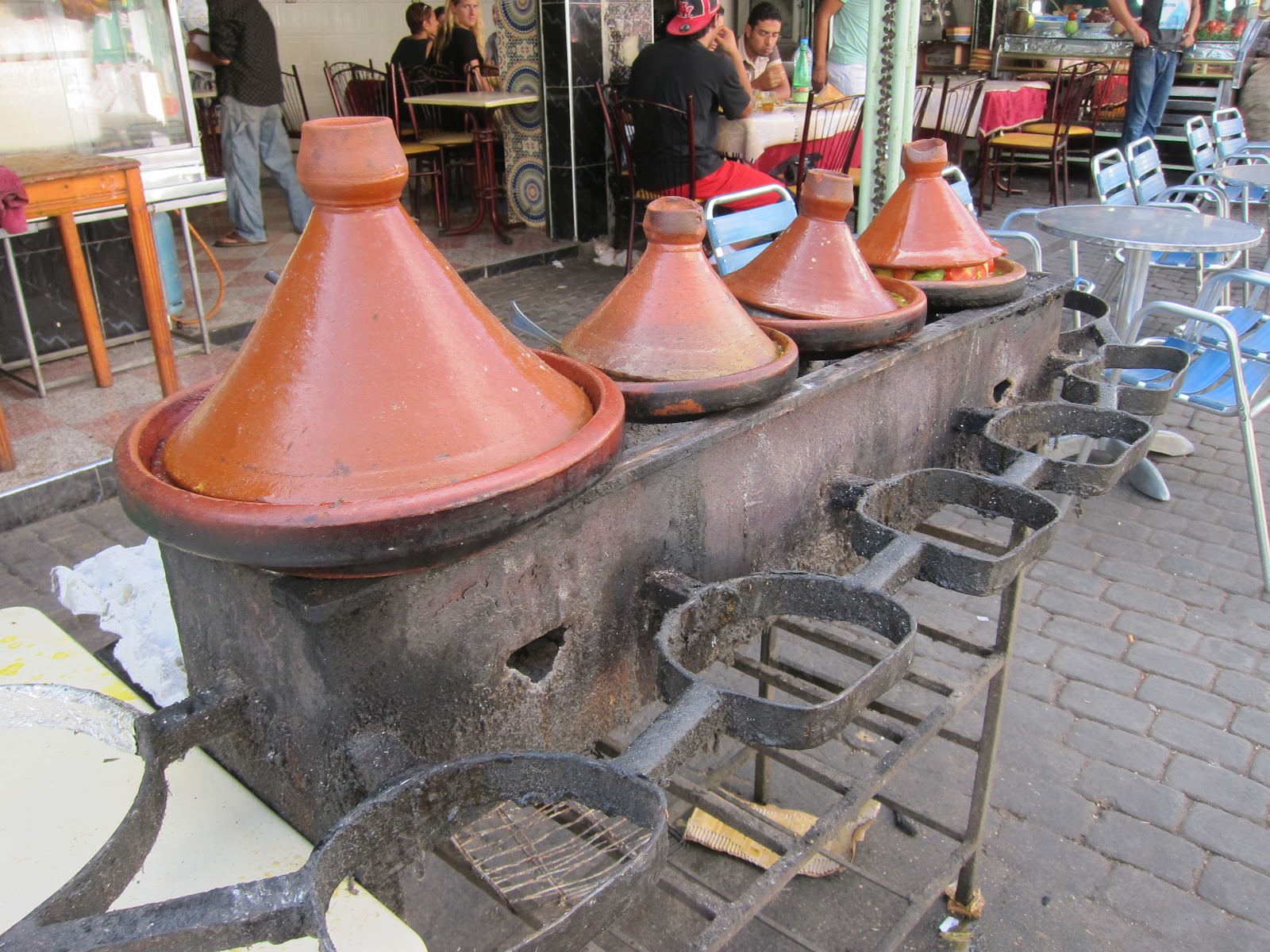
Wearing a bright red fez, Abdoul cooks outside in front of the restaurant. Opposite the cash register a row of clay tangines cook on a metal tray.
He checks the progress of the tangines and returns to his elevated kitchen on the other side of the outdoor area.
He smiles as he forms ground beef into thick dowels and places them into wire grilles with two sides. He flips one side on top of the other and places the meat on the gas powered grill next to ones filled with sliced tomatoes, onions and eggplant. 

He fills two more wire grilles with chicken and beef fillets and adds them to the others. Fat from the beef explodes into flames. Abdoul deftly controls the fire by flipping the grilles on top of one another. A spray of water beats back the flames.
At the table, the conical top of a tangine is removed as if it were a hat removed out of courtesy. Sliced carrots, zucchini, string beans and chunks of potato have cooked in a bubbling broth. The heat from the flames having created a thick sweetened crust on the bottom of the tangine that requires tugging to remove.
Baskets of soft white bread appear as well, along with small plates of stewed white beans, cooked potato cubes in tomato sauce, spicy herbed green and black olives, thick cut French fries and two wonderfully crisp potato croquettes that we share with great relish.
The fruit of Abdoul's fiery labors come to the table, a mix of charred meats, flavored by their own fat and the smoky flames, and the vegetable slices still mostly raw but singed and sweetened by caramelization.

Knives and forks give way to fingers tearing pieces of the soft white bread that are dipped into the tangine to soak up the delicious broth, then picking up pieces of onion, tomato and eggplant along with a choice of chicken and beef two ways.

Each mouthful benefits from a marriage of salt and fire sweetened fat. Here is umami, Arabic style. The whole much larger than the parts.

Against this marriage of flavors, the crispy croquette holds its own. The olives, French fries and white beans are in supporting roles. They might be overlooked entirely in the competition for attention but they also serve who stand and wait and in short order they too are consumed along with their more popular brethren.
Very full, we stagger back to the van, aware that we are only half-way through our first day and there is so much more to experience.  Still working in front of his fires, Abdoul gives us a big wave and a smile as we leave.

Friday, October 5, 2012

Morocco from Casablanca to Fez

I posted the article about our first day in Morocco when we were on the road. I used my iPad and discovered once again that Google, which created Blogger, and Apple do not play well together.


The software I used to post my article would not allow me to add photographs. So much of what I was talking about needed images to communicate what we were seeing.

Now that I am home, I can use my laptop which allows me to upload the photographs so I'm reposting the article.

From Casablanca on the coast to the inland city of Fez in the northern part of Morocco, the area looks very much like the American Southwest.

Looking out the window of the van, there's not much to see.
A well-paved highway cuts through the flat, dusty farmland, passing villages remarkable only for the number of flat roofed houses with satellite dishes and the occasional donkey cart.

I'm with a group of travel and food writers visiting Morocco. Some of us are here for the first time.

Before we leave Casablanca we stop at the Mosque Hassam II, the 3rd largest mosque in the world, the largest in Morocco. 
The scale of the doors makes visitors look very small. The detailing on tiles and metal work on the tall doorways is beautiful. The mosque overlooks the breakwater and harbor.

A few blocks away, restaurants and clubs share the same view. 
We grab a quick breakfast after our all-night flight before we climb in the van for a three hour drive.

Passing through villages along the way, small roadside cafes and stores selling drinks and snacks are the only commerce visible from the road. On the outskirts of Menekes we see something that makes us stop the van and get out for a look.

Open air meat markets.
When you see that, you know you aren't in Kansas anymore. The butchers are friendly. Sides of beef and sheep hang outside in front of the shops. Cuts of meat are laid out on the counters.
From that dusty scene we head on to Chateau Roslane, the largest winery in Morocco and worlds away from the butcher shops. A large, well-landscaped facility, we have a tasting of white, red and rose wines. All very good. Light and perfect for a summer meal.
For lunch we eat in the hill-top holy city of Moulyidriss. The buildings press against one another, moving like waves up the hills and down into the valley.
We want an authentic Moroccan meal. 

We have lunch on what our guide says is called "the Food Street," because there are small cafes mixed in with dry goods stores and stalls selling olives and bread.
Restaurant Alaambra is a hole in the wall. An open-air space with a dining area in front with a cash register on one side and a few plastic covered tables in the middle. 
The tables and chairs look like they came from someone's house. A larger dining room is in back. We sit out in front where we can watch the cook prepare the meal.
Wearing a bright red fez, Abdoul cooks outside in front of the restaurant. Opposite the cash register a row of clay tangines cook on a metal tray.
He checks the progress of the tangines and returns to his elevated kitchen on the other side of the outdoor area.
He smiles as he forms ground beef into thick dowels and places them into wire grilles with two sides. He flips one side on top of the other and places the meat on the gas powered grill next to ones filled with sliced tomatoes, onions and eggplant. 

He fills two more wire grilles with chicken and beef fillets and adds them to the others. Fat from the beef explodes into flames. Abdoul deftly controls the fire by flipping the grilles on top of one another. A spray of water beats back the flames.
At the table, the conical top of a tangine is removed as if it were a hat removed out of courtesy. Sliced carrots, zucchini, string beans and chunks of potato have cooked in a bubbling broth. The heat from the flames having created a thick sweetened crust on the bottom of the tangine that requires tugging to remove.
Baskets of soft white bread appear as well, along with small plates of stewed white beans, cooked potato cubes in tomato sauce, spicy herbed green and black olives, thick cut French fries and two wonderfully crisp potato croquettes that we share with great relish.
The fruit of Abdoul's fiery labors come to the table, a mix of charred meats, flavored by their own fat and the smoky flames, and the vegetable slices still mostly raw but singed and sweetened by caramelization.

Knives and forks give way to fingers tearing pieces of the soft white bread that are dipped into the tangine to soak up the delicious broth, then picking up pieces of onion, tomato and eggplant along with a choice of chicken and beef two ways.

Each mouthful benefits from a marriage of salt and fire sweetened fat. Here is umami, Arabic style. The whole much larger than the parts.

Against this marriage of flavors, the crispy croquette holds its own. The olives, French fries and white beans are in supporting roles. They might be overlooked entirely in the competition for attention but they also serve who stand and wait and in short order they too are consumed along with their more popular brethren.
Very full, we stagger back to the van, aware that we are only half-way through our first day and there is so much more to experience.  Still working in front of his fires, Abdoul gives us a big wave and a smile as we leave.

Thursday, May 22, 2008

Wilted Spinach Salad Takes Center Stage

Everyone has an all-purpose dish that can be modified in clever ways by changing a few key ingredients. For my mother, it was the casserole. For me it’s usually pasta but on those nights when my wife wants to “go green” I turn to an old stand-by: a wilted spinach salad.

Versatile spinach works cold in a salad or heated by sautéing or boiling. A hot dressing brings spinach to a middle ground: mostly raw with some leaves wilted from the heat of the dressing. Sautéing the dressing allows for a great variety of ingredients: Italian sausage, anchovies, mushrooms, shrimp, bacon, chicken, duck, chicken livers, or purely vegetarian. As far as I can tell just about any pizza topping would work on a wilted spinach salad, excepting maybe pineapple.

I invite everyone to send in suggestions. I know I’ve only scratched the surface of this infinitely variable dish.

Wilted Spinach Salad with Shrimp, Avocado, and Olives
Yield 4 servings
Time 20 minutes

Ingredients

1 large bunch spinach, the root ends trimmed and discarded, thoroughly washed to remove the grit
2 garlic cloves, peeled, thinly sliced
2 slices bacon, finely chopped (optional)
6 mushrooms (brown or shiitake), washed, thinly sliced
1 carrot, peeled, cut into rounds 1/4" thick
2 shallots, peeled, cut into thin rounds
12 shrimp, medium sized, washed, deveined, sliced in half (optional)
12 olives (oil cured black, green split, or Castelvetrano green), pitted, quartered
1 small avocado, peeled, roughly chopped
1/4 cup croutons, preferably homemade
2 tablespoons feta, crumbled (optional)
4 tablespoons olive oil
4 tablespoons balsamic vinegar
Sea salt and pepper

Remove the stems from the spinach. Put the leaves into a large salad bowl. Finely chop the stems. To make the hot dressing put 2 tablespoons of the olive oil into a sauté pan on a medium flame and lightly brown the spinach stems, garlic, bacon, mushrooms, carrot rounds, and shallots. Remove from heat and set aside. In a small sauce pan reduce the balsamic vinegar to 1 tablespoon. In a separate sauté pan drizzled with olive oil, cook the shrimps until pink about 2 minutes, then set aside.

When you’re just about to serve the salad, reheat the dressing on a medium flame. Add the rest of the olive oil, olives, and avocado.

Using a rubber spatula pour the hot dressing over the spinach leaves. Drizzle with the reduced balsamic vinegar. Top with the shrimp, croutons and if you want the feta. Taste and adjust the seasoning with sea salt and black pepper.

Variations

The hot dressing can be kept vegetarian by using olive oil, shallots, and garlic. Most vegetables can be added to the sauté: zucchini, carrots, mushrooms, English peas, sugar snap peas, broccoli, or tomatoes. Try tofu or vegetarian patties as well.

A riff on a chef salad, in the dressing sauté baked ham and turkey breast with shallots; add cheese (cheddar or Swiss) and chopped tomatoes when you toss the salad.

Borrowing from the classic frisee salad, use bacon or lardoons crisped in the sauté, topping the salad with a fried egg. A variation on a variation: instead of a fried egg, use a hard boiled egg, sliced or chopped.

Sauté 1/4" rounds of Italian sausage with slices of red pepper, onion, and garlic to make a wilted salad version of a sausage hero.

Grilled or sautéed chicken livers with mushrooms, onions, and lots of garlic.

Add several anchovies and a dusting of pepper flakes to the onion-garlic sauté.

For the meat use slices of roast duck or chicken (dark meat preferably since it has more flavor); put shiitake mushrooms in the sauté.

Sunday, April 13, 2008

With a Little Help from a Friend I Discovered Guidi Marcello's deli

Cooking is one of life's great pleasures. But routine can be its enemy. Always using the same recipes, the same ingredients, or shopping at the same markets will wear down even the most foodie of cooks. I'm very grateful when someone puts me onto a new direction that reinvigorates my cooking. My good friend, Alexandra, an expert in all things Italian, did just that when she told me about the wholesale/retail importer Guidi Marcello (1649 10th Street, Santa Monica, CA 90404, 310/452-6277). The outside of the building is so nondescript I didn't find it at first. Inside is one of the best selections of affordable Italian imports in Los Angeles: cheeses (cow, sheep, goat), olives, cured meats, frozen desserts, pastas, olive oils, ceramics, breads, spices, chocolates...

There are so many great ingredients to try it's difficult to know where to begin. I started with the olives because I seem to be stuck in a routine of buying oil cured black and cracked green olives at Iranian markets. Guidi Marcello has rows of olives I hadn't seen before. One in particular looked intriguing: Castelvetrano green olives. Grown in Sicily, the olives are packed green and brine cured. The buttery flavor is quite surprising and delicious. Using them in a simple salad shows off their qualities.

Mozzarella Salad with Green Olives, Avocado, and Reduced Balsamic Dressing

For the dressing I like a simple mix of extra virgin olive oil and reduced balsamic vinegar, seasoned with sea salt and black pepper. I've talked about making balsamic vinegar reduction in quantity but for one salad just reduce 4 tablespoons of vinegar to 1 on a low flame in a sauce pan. The vinegar turns sweet. Let it cool and drizzle it over the salad with the olive oil. You can buy the fresh mozzarella at Guidi's or around the corner at Bay Cities Deli where they also carry the extraordinary Felino salami.

2 large fresh Mozzarella pieces, dried, cut into 1" squares
1 small ripe avocado, peeled, cut up
15 green olives (Castelvetrano or any other good quality olive), pitted, quartered
6 slices salami (Felino or any other good quality salami), casing removed, julienned
2 tablespoons extra virgin olive oil
1 tablespoon reduced balsamic vinegar
Sea salt and pepper

Combine all the salad ingredients in a large bowl, drizzle with the olive oil and reduced balsamic vinegar, and season with sea salt and freshly ground black pepper. Toss. Serve with a fresh baguette and sweet butter.

Serves 2. Preparation Time: 10 minutes.

Thursday, February 21, 2008

Home Alone: What to Do When Your Family Leaves You to Your Own Devices

I work at home and the days can be a bit like Chinese water-torture: wake up, do the laundry, clean up, run around doing errands, cook dinner for my wife and son, make a fire, watch TV (In Treatment; The Daily Show; Colbert), and crash. It's not a bad routine. It's actually kind of great. And yet I'm not in control of my choices or my time.

Yesterday Michelle told me she had to go to a reception for work. Normally our youngest son, Michael, would be home for dinner, but he was flying up to Seattle to look at a college. I had one of those envy-flashes: "They're having all the fun." What was I going to do? I could go to a movie, but I don't like going to the movies alone. I could stay home and make dinner for myself, but cooking just for me sounded sad.

Then I had an epiphany: Home alone...I could eat anything I wanted for dinner.

Michelle doesn't like blue cheese, so I could make an Arugula Salad with Crispy Bacon and Blue Cheese. Michael doesn't like steak, so I could defrost and grill a nice rib eye steak. And what about a drink before dinner? A Perfect Manhattan with a twist. A Caipairina with Lime and Kiwi Fruit. A tumbler of the rum we brought back from our trip to Havana in 1990. Or maybe a Dirty Martini.

Doing an errand, I passed Bay Cities, a great Italian deli in Santa Monica. I decided to stop and get some treats. Inside there were aisles of olives, cheeses, salamis, Italian sausages with fennel, hams, prosciutto, breads, pastas, anchovies, and snails. I got carried away and bought enough to eat for days.

Back home I found another treasure, a jar of American caviar that Michelle had gotten in one of her Sundance Festival goodie bags.

My mind was racing. If I didn't calm down, I'd need a Lipitor chaser and an epi pen at the end of the meal. I decided against the Arugula Salad with Blue Cheese and focused on basics: a charcuterie plate with prosciutto, mozzarella, green olives, and fresh Italian bread. The caviar I'd have on slices of bread. The main course: the rib eye steak, grilled medium rare. For a side dish, artichokes with melted butter. To start, a Perfect Manhattan.

A Perfect Manhattan

4 oz. Bourbon or Whiskey
½ oz. Sweet Vermouth
½ oz. Dry Vermouth
1 twist of lemon peel, 1" long, ¼" wide

Keep the Bourbon in the freezer so it will be extra cold. Pour the Bourbon and both vermouths into a martini glass, stir, drop in the twist, and sip contentedly.

Serves 1. Preparation Time: 2 minutes.

A Charcuterie Plate

From a good deli, pick out a selection of your favorite meats,. Some of the best are handmade by Paul Bertolli for his Fra' Mani label. You can find a selection of his salumi all over LA, especially at Joan's on Third, Whole Foods, or Surfas. For my plate, I laid out paper thin slices of prosciutto, slices of my favorite salami, felino salami, green olives, and mozzarella dredged in seasoned olive oil, with slices of Italian bread, drizzled with olive oil.

Grilled Steak

In college I was a vegetarian, but ultimately I missed eating meat too much and I re-discovered hot dogs, hamburgers, roast chicken, and steak. There is nothing that tastes quite so good as a steak, simply grilled, seasoned with sea salt and black pepper.

1 10 oz. steak, T-Bone, Porterhouse, Rib Eye with the Bone-in, washed, pat dry
Olive oil
Sea salt
Freshly ground black pepper

I've talked before about the advantages of marinating meat with a simple, seasoned olive oil marinade before freezing. The meat stays tender and fresh-tasting, even after weeks in the freezer. Defrosted and brought to room temperature, the steak was ready for the grill. Seared on one side for 5 minutes to get the grill marks right, turned over for another 5 minutes to get that side marked, then for 5 minutes on each side again. The steak came out cooked perfectly: medium rare. Letting the steak sit for 5 minutes, covered with tin foil, the juices began to run. The steak was ready to join the feast.

Grilled Artichokes with Melted Butter

1 artichoke, washed, the stem trimmed, the sharp ends of each leaf cut off
2 tablespoons sweet butter, melted
Sea salt
Freshly ground black pepper

Cut the artichoke into 8 sections. Use a sharp paring knife to remove the choke from each section. Drop the artichokes into boiling, salted water, cover, cook for 30 minutes, drain, and put into a large bowl. Drizzle the artichoke sections with olive oil, sea salt, and black pepper. Toss well, then grill on the bbq on all sides. Serve with the melted butter and sea salt.

Home alone...not so bad.