Friday, March 24, 2017

Best Ever Pasta With a Secret Ingredient

The holy grail of home cooked meals is a dish that takes practically no time to make, the ingredients are inexpensive and the results are delicious.

I found a pasta dish that fits all of those criteria.

The ingredients are basic. Olive oil, tomatoes, onions, mushrooms and a green vegetable like asparagus. The seasoning is straight forward, just a little sea salt, black pepper and, if you like, a pat of sweet butter. By the time the pasta is al dente, the sauce is finished.
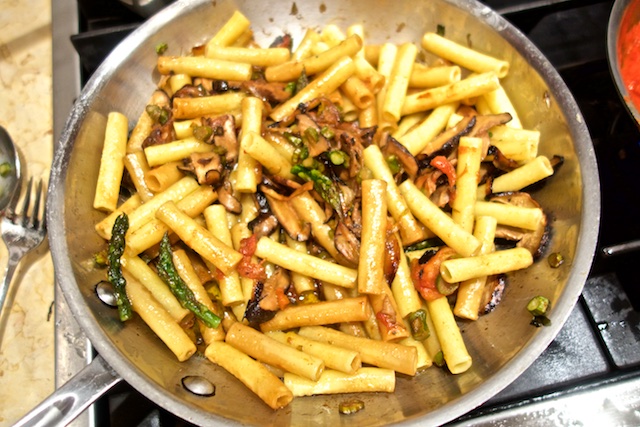
Anchovy filets are the special ingredient that creates an extraordinarily delicious pasta.

If you have enjoyed spaghetti alla puttanesca in an Italian restaurant, my recipe is similar but with more delicate flavors.

Even people who don't like anchovies by themselves fall in love with this sauce because the anchovies dissolve, binding together all the flavors. The result is an earthy, deeply satisfying dish.

Anchovies, a gift from the sea

Anchovies are a ubiquitous ingredient in Mediterranean cuisines. Stop in a neighborhood cafe in Northern Spain, as I did in the cathedral town of Burgos, and you will certainly have a tapas with an anchovy filet skewered along with a pepper, pickle and an olive or two. Those delicious filets are front and center on the dish, displayed in all their fish-filet-glory. With an espresso or an ice cold glass of beer, nothing is better for an afternoon snack.
Use high quality Spanish or Italian anchovies preserved in oil. Do not use salt preserved anchovies, ones wrapped around capers or filets with skin. 
Anchovies are sold in 2-4 ounce tins or glass jars. buy anchovies in larger quantities like Flott's 28 ounce tin. That way I always have them in the refrigerator to add to deviled eggs or tapenade. Kept in an airtight container and submerged in oil, the anchovies will keep for months.

Best Ever Pasta Sauce

Use a quality pasta like De Cecco or, if available, fresh pasta.  For this dish, I prefer a medium weight pasta like spaghetti, pappardelle, ziti, orecchiette or penne.  

Chopped fresh tomatoes can be used, but they are not as flavorful as roasted tomatoes which have an earthly sweetness. 

Roasted tomatoes can be prepared ahead and kept refrigerated in an airtight container for up to three days or frozen for up to three months. 
During the winter at the Santa Monica Farmers Market, there are still farmers who bring tomatoes to market. Sold at a deep discount because they are misshapen and cracked. These "ugly" tomatoes are beautiful inside. With a little care and the discolored parts cut away, a roasted winter tomato has a delightful, deep-flavored sweetness.

To add crunch and visual contrast, add a lightly cooked green vegetable. Depending on what is available I use green beans, asparagus or broccoli greens. 

Serves 4

Time to prepare and cook: 15 minutes

Ingredients

1 pound pasta, a quality brand or fresh
1 tablespoon kosher salt
10-16 anchovy filets depending on taste 
2 tablespoons extra virgin olive oil
1 whole large tomato, washed, pat dried, stem and any blemished skin cut away
1 pound asparagus stalks, washed, stem ends snapped off
1 small yellow onion, washed, root and stem ends and outer skin removed, chopped into large dice
1 cup brown, shiitake or Chanterelle mushrooms, stems trimmed, dirt removed, lightly washed and pat dried, thin sliced top to bottom
1 tablespoon sweet butter (optional)
Pinch cayenne powder (optional)
1/4 cup chopped Italian parsley, washed, pat dried, leaves only, finely chopped for garnish
1/4 cup freshly grated Parmesan or Romano cheese
Sea salt and freshly ground black pepper to taste

Directions

Preheat oven to 450F.

Cut tomato into 3 large, round slices. Line baking sheet with Silpat or nonstick sheet. Place tomato slices on sheet and place in oven. Cook 10 minutes. Remove from oven. 

Place large pot on stove filled with water to within 4" of the rim. Add kosher salt. Bring to boil. 

Cut asparagus stems into 1/4" rounds. Leave the last 2" of stem attached to the spear. Set aside.

Heat 1 tablespoon olive oil in large frying pan on medium flame.

When the salted water boils add pasta. Stir well and stir every 3 minutes for even cooking. Do not cover. Place a colander in the sink next to a heat-proof measuring cup.

Sauté onions until translucent in the heated oil. Add mushrooms and asparagus. Stir well and sauté 3-4 minutes.

Push vegetables to one side of the frying pan to clear space for the anchovy filets. Add another tablespoon olive oil. Allow 1 minute to heat. Using a sturdy fork, gently stir the anchovies into the heated oil until they dissolve. Toss the vegetables in the sauce. 

Tear apart the tomato slices. Add the bits and pieces and all of the accumulated oils from the baking sheet into the sauté pan. Add sweet butter (optional) and a pinch of cayenne powder (optional). Stir to melt butter. Toss well to integrate the sauce and coat the vegetables.

Taste pasta after 10 minutes to confirm it is al dente. When you strain the pasta in the colander, capture 1 cup of pasta water in a heat-proof cup.

To prevent sticking, toss pasta.

Just before serving, transfer pasta into frying pan. Separate any that are sticking together. Toss to coat with sauce. If a little more sauce is needed, add 2 tablespoons pasta water and toss. Add more pasta water if more sauce is desired and stir.

Transfer pasta into serving bowl. Top with finely chopped Italian parsley and serve with freshly grated cheese on the side.

Tuesday, March 14, 2017

A Young Chef Practices His Craft in an Art Gallery

Dinner begins on a dark and windy night. An errant newspaper skitters across the street. My invitation to a tasting by chef Paul Shoemaker, says the address is 4200 Lankershim Blvd, North Hollywood 91602 but the entire block looks abandoned. Using my iPhone as a flashlight, I locate the numbers on the building although a battered sign says this is the Evolution Dance Studios.

To escape the darkness, I follow a rectangle of amber light. Just beyond the doorway, the entryway brightens with stylish lighting and colorful paintings on the wall. A plaque declares this is INTRO. A few steps more and I’m inside a large space with a beautifully set communal table. Overhead bare bulbs hang like trapeze artists. Bingo! I’m here.

General manager, Rob Ciancimino greets me with a flute of light and dry Marcopolo prosecco.  I join the other twenty guests and wander around the space, which doubles as an art gallery. The colorful paintings are by Oscar Meza, a multi-talented professional skateboarder and artist.

Rob returns to see if anyone needs a refill. Glasses are raised and he pours. He is amiable, entertaining, charismatic, stylish and attentive. He tells the group that he is happy we’ve joined him tonight.  INTRO is open for Friday and Saturday night dinner and available for private events. All of this is prelude to the fall when he and his partners will open Verse, a bar, club and restaurant down the block.

It’s time to take our seats and read the menu. The fourteen courses are a mix of elegant ingredients (big eye tuna, foie gras, Maine lobster and Hamachi) and comfort foods (beets, dates, bone marrow and ravioli). And because this is fine dining, there will be wine, including a tasting of wines hand carried by Matthew Ospeck from AuburnJames winery in St. Helena.

As we are introducing ourselves to our table mates, Ciancimino sounds a small chime. It's time to begin our meal. Shoemaker comes out of the kitchen to talk us through his first dish, an Edible Cocktail. A Meyer lemon icy-foam gin martini shares a block of charred wood with two Asian spoons. We raise our glasses to salute the chef and each other. The cocktail is delicious and fun like eating a best-ever lemony snow cone. Then we feast on the spoons, enjoying the mix of textures, temperatures and flavors. Sweet, frozen, crunchy, spicy and acidic sensations roll around in our mouths. The evening begins with a “wow”.

The next dish riffs on the great versatility of salmon. Half a dozen roe are scattered on top of a thin slice of sashimi quality belly meat which in turn is placed on a strip of salmon skin cooked to chicharon-crispness. Designed as a sensory encounter, when placed in the mouth, the skin evaporates and the roe releases its salty creaminess. Even after the last bit of pliant belly meat has been consumed, the favor sensation continues with the heat of Togarashi, the wonderful Japanese pepper powder.

That experience is exactly what I expect from a fine dining chef. A mastery of technique. Flawless execution. Artful plattings. Inventive pairings of textures. 

For this dinner, each dish, from the first to the last, from small plates of single bites like the bone marrow ravioli or the butter poached lobster to the larger plates of Hamachi and hanger beef steak, demonstrates Shoemaker’s culinary talent. His flavors are balanced. Every element has a contrary element. Sweet is paired with acidic. Crispy with pliant. And, more often than not, a gentle heat lingers at the finish to prolong the experience. 

Adding to the sensory experience, each dish is beautifully platted. Some dishes ae served on charred blocks of textured wood. Others in pure white porcelain bowls. Shoemaker arranges the edible ingredients like an artist applying paint to canvas. The ingredients are as much a part of the visual portrait of the dish as they are part of the flavor composition.

Each time the chime sounds, we are alerted to the beginning of a new adventure. 

For the sixth course, a single Maine scallop in a porcelain white bowl is placed in front of me.  Cross-hatched with grill marks, the pink-white scallop the size of a silver dollar rests on a pillow of avocado mousseline next to a pale white cube of pickled daikon, smaller than a dime. At the bottom of the bowl, chef poured a pool of house-made ponzu broth with a gathering of white and black sesame seeds. The scallop is paired with AubernJames’ Meritage 2010 (Napa Valley), a lovely, crisp white that compliments the delicate flesh and acidic broth.

Selecting the ingredients for this dish as with all the others, Shoemaker searches for the best ingredients. If he can't find what he wants locally, he looks elsewhere. 

What Shoemaker serves depends on the seasons. While I am walking around his kitchen he tells me with a big smile that this week he is expecting a FedEx delivery of Dutch white asparagus. He is the kind of chef who delights in the perfections of the moment. Who will source ingredients from half-way-around the world. 

In his travels he is always on the look out for quality providers, which is how he found the fisherman in Maine who supplied him with the scallops for our dish. And the scallop is perfect. Tender. Slightly sweet. Full of briny flavor.

A DIY Kitchen Produces Sophisticated Results

Looking at the complexity of each dish, it is easy to visualize Shoemaker’s kitchen. It must be high tech, fitted out with the latest gadgets. Given the detailing of the platting, surely there must be a dozen sous chefs bending over plates with tweezers picking micro greens from their mise en place. 

Nope.

Shoemaker’s kitchen is a large space with a playhouse feeling.  When I walk in, one of the chefs is taking a break on a rope swing secured to the ceiling. There are some high-tech tools like a sous-vide cooker but INTRO’s kitchen is very basic. The two 1970s era stoves were purchased on eBay. There is no grill so with DIY inventiveness, to place grill marks on the scallop, the chefs use a kitchen torch to heat a knife red hot. Pressing the sizzling knife against the scallop creates the cross-hatch marks and adds a hint of caramelization.

Back in the art gallery-dining room, the chimes sound. To explain the dish, Shoemaker reappears as the servers place the next dish in front of each diner.

Foie gras is served nigiri style, on pressed rice. Who would have imagined that fat slices of beautifully charred foie gras go so well on vinegared rice, itself also lightly charred on the bottom to create a thin crust? The sweet acidic flavor so essential to balance the richness of the foie gras comes from a single blackberry sliced in half and a dollop of sour plum sauce.

Talking about the meal, everyone has their favorite dish. Mine is the pork belly. A fat triangle of pork skin is fried to airy crispness. Which contrasts perfectly with the fork-tender, apple cider poached pork belly served with a sunny-side up quail egg, the yolk still runny, and pureed sweet potato flavored with maple syrup with bourbon. As we eat, all conversation ends. We focus on savoring each bite. I swab bits of pork belly into the richly sweet sweet potato being sure to add a bit of egg yolk and maple syrup.

As people eat, they can't help exclaim, “Wow.” “That’s amazing.”

I reach for my glass of AuburnJames' delicious Cabernet Sauvignon 2009 Napa Valley and notice that chef leans against the wall in a corner of the room. Clearly he is an impresario who takes delight in hearing us appreciate his creations. 

As we finish dinner, Shoemaker brings out his crew. Like the end of a theatrical performance, the cast takes a curtain call. Seen on the street, his cooks would be mistaken for skateboarders. To our applause he stands smiling with Paul Richardson, Erik Punzalan, Raymond Morales, Dro Dergy and Joel Ocampo. 

At that moment it seems abundantly appropriate that this space is named INTRO. With this pop-up chef’s table, Ciancimino is introducing Shoemaker to his customers. What an excellent way to get to meet such a talented chef and enjoy his food in an intimate dining experience.


INTRO: Art Gallery & Chef’s Table, 4200 Lankershim Boulevard, North Hollywood 9160. Champagne is served at 7:30pm. Dinner begins promptly at 8:00pm. http://www.experienceintro.com; reservations on https://resy.com/cities/la/intro-art-gallery-and-chefs-table

Thursday, March 2, 2017

A Video Walk-Through Tsukiji Fish Market: Fighting To Save Tokyo’s Culinary Heritage


A food counter serving tuna bowls at the Tsukiji Fish Market in Tokyo. Credit: Copyright 2016 David A. Latt
If you received this post by email, the link below to the YouTube video tour of Tsukiji may be faulty. If that is the case, please click here to go directly to my YouTube Channel: Secrets of Restaurant Chefs.

Located in central Tokyo, Tsukiji is the largest fish market in the world with separate wholesale and retail areas. Besides being the source for most of the fresh fish served in Tokyo’s sushi bars and restaurants, Tsukiji is the best food court imaginable.
On a recent trip to the market, like everyone else on the crowded sidewalk, I had come to see what wonderful ready-to-eat dishes were for sale. I didn’t know what I wanted, but I knew I would find something delicious at one of the closet-sized stalls.
In those tiny spaces, chefs stand close to customers as they prepare sushi and sashimi with freshly caught ingredients. Fat oysters steam in shinny stainless steel pots. Thick braids of smoke rise up from scallops and crabs cooking on blazingly hot grills. Tempura vegetables and shrimp sizzle in hot oil before arriving crisp and tender on a paper plate. Ramen noodles are drained and ladled into large bowls with servings of thick savory broth, topped with slices of sticky pork and half a hard-boiled egg.
The great variety of dishes available means a stall selling curry is a few steps from another selling shumai and pork-filled bao, and that stall is around the corner from a cook grilling skewered scallops topped with sea urchins.
I wanted to taste everything.
And yet, for all these wondrous treats, the city of Tokyo wants to tear down the market.  The last time I visited, the city had slated Tsukiji for demolition. That the market was still open was a wonderful surprise.
Visiting Tsukiji this trip, I felt like I was seeing a long-lost friend. I brought my video camera to record what it is like to walk through the market before it is gone forever.

Urban progress, a culinary loss

Main entrance at the Tsukiji Fish Market in Tokyo. Credit: Copyright 2016 David A. Latt
The main entrance at the Tsukiji Fish Market in Tokyo. Credit: Copyright 2016 David A. Latt
So, if Tsukiji is so wonderful, why does the city want to tear it down?
The market occupies valuable real estate in a congested part of Tokyo. In a real estate-starved city, the market occupies acres of land that could be used to construct large building complexes that would bring in much needed revenue.
Tearing down the market would also eliminate the truck traffic in and out of the wholesale market. So it makes sense to move Tsukiji out of the city. On the other hand, removing Tsukiji is bad for tourism because every day thousands of people crowd the sidewalks and walkways inside the retail areas.
The conflict between these competing interests was all but resolved when the city spent $5.71 billion U.S. (¥588 billion) to construct a replacement facility in Toyosu, Koto, a suburb of Tokyo.

Tsukiji Fish Market’s uncertain future

Vendor selling tuna fillets at the Tsukiji Fish Market in Tokyo. Credit: Copyright 2016 David A. Latt
A vendor selling tuna fillets at the Tsukiji Fish Market in Tokyo. Credit: Copyright 2016 David A. Latt
So why is the market still open?
The previous governor of Tokyo, Shintaro Ishihara, had made closing Tsukiji a priority. With the 2020 Olympics coming, the land was needed for other purposes and his administration said there were sanitary problems at an antiquated facility that opened in 1935.
When Yuriko Koike was elected governor in 2016, she reopened an inquiry into the cost overruns at the new Toyosu facility and she took seriously vendor complaints that rents at the new facility were considerably higher than at Tsukiji. So much higher that many preferred to go out of business rather than relocate to Toyosu.
Those issues were important, but what halted the demolition was something unexpected.
Remarkably, the Toyosu facility was constructed on landfill polluted by a gas plant, the previous tenant. Those health reasons were serious enough for Gov. Koike to halt the relocation of Tsukiji.
For now, the market is open for business. For how long is the question. A modified demolition has been proposed that would keep the retail part of the market where it is. The food stalls would continue to feed the many visitors and locals. The wholesale operation would move to Toyosu. But if that will happen and when are open questions. At the moment, Tsukiji’s demolition is still part of the city’s master plan.
If you are going to visit Tokyo, put Tsukiji at the top of your list of destinations to visit. Come hungry because you will want to sample the ready-to-eat food.
Allow several hours so you can explore the market without rushing. Absorb the sights and aromas of the market. Take it all in as if this were your last visit, because it just might be.


Saturday, February 18, 2017

The Best Ever Chicken Wings for the Best Ever Oscar Night Party


Watching the Oscars culminates a year of film releases and award shows. This year the Best Picture nominees group together films of extreme differences. Imagine a double-feature of La La Land and Hacksaw Ridge. Ok, don't imagine that.

My favorite films were Lion and Manchester By the Sea. Both were emotionally engaging and structured like thrillers.

For Sunday night I want to make a special plate of nibble-food, something that has some art and cultural diversity in its design. With that in mind, I hope you will try my use of a Vietnamese sauce to flavor the classic American bar dish, chicken wings.

Fusion how I love thee

The best aspect of fusion cuisine is when you discover a combination of seemingly unrelated flavors or components that, once you’ve paired them, make you think they have always naturally belonged together.
For me, the surprising match was an American bar food staple and an Asian comfort-food classic.
The popular Vietnamese dish pho, a giant soup bowl filled to the brim with meat and noodles, is traditionally served with a basket of fresh green vegetables and bean sprouts.. For seasoning, a dipping sauce is also provided.
As a matter of personal taste, I prefer the lighter pho ga, made with chicken, to its deeper flavored, beefy cousins. After years of eating pho ga I realized that part of my craving for the soup was because I loved the dipping sauce called nuoc cham gung.
Vietnamese pho
In the sauce, finely minced ginger and garlic mingle with flecks of dried Sichuan peppers in a vinegary-salty-sweet sauce, accentuated with lime-citrus notes.
With one of those wonderful epiphanies that happen to people who think about food a bit too much, I realized that nuoc cham gung would make a good marinade and glaze for my favorite appetizer, Buffalo wings.
Chicken on the bone, cooked on the grill or in the oven, has a moist-sweetness that is accentuated perfectly by my modified version of nuoc cham gung.
Because of its deeply flavored saltiness, fish sauce, variously called nuoc mam in Vietnam or nam pla in Thailand, is an essential ingredient in the recipe. Easily found in Asian markets, the sauce is inexpensive and lasts for years in the refrigerator.

Vietnamese Buffalo Wings

Serves 4 as an entrée or 8 as an appetizer
Ingredients
2 pounds chicken wings, washed, disjointed, wing tips discarded or reserved and used to make stock
½ cup white sugar
½ cup warm water
¼ cup fish sauce, preferably a light caramel colored brand
¼ cup white vinegar
2 teaspoons fresh lime juice
4 cloves garlic minced
1 dried Chinese Szechuan pepper, stem removed, seeds and skin minced
3 tablespoons or 3-inch piece ginger, peeled, minced
2 tablespoons brown sugar, to taste
Directions
  1. In a large non-reactive bowl, dissolve the white sugar in warm water. Add the other ingredients, stir to mix well and add the chicken wings. Transfer to a sealable plastic bag and refrigerate one hour or, preferably, overnight.
  2. Remove the wings and transfer the marinade to a small saucepan, adding the brown sugar. Stir to dissolve and reduce by a half or, if you want a thicker glaze, by two-thirds over a medium flame to create a glaze that should have a good balance of sweetness and heat. Taste and adjust for more sweetness if desired by adding another tablespoon of brown sugar.
  3. The wings can either be grilled on a barbecue or baked in a 350 F oven on a rack on a baking sheet lined with aluminum foil for easy clean up. Turn every 10 minutes. Cook until tender, about 30 minutes.
  4. Place the wings on a large plate of Asian noodles, steamed rice, or shredded lettuce. Just before serving, pour the hot glaze over the top.


Friday, January 13, 2017

When You Don't Have Time to Cook But You Still Want a Home-Cooked Meal, Do This!

Home cooked meals are definitely better for you and less expensive, but sometimes cooking seems too difficult and time-consuming.

When you're tired and hungry, it seems easier to stop for take-out on the drive home, order in or nuke those Trader Joe's frozen Shrimp Soft Tacos you bought last week.

But with a little effort (not much) and even less time (minutes), you can prepare two easy-to-make vegetable dishes that combine well with a charred steak, sautéed tofu or roasted chicken breasts which cook in no time at all.

Salt-boiled vegetables

Salt boiling cooks vegetables quickly. Cook them as little as possible so they have a crisp, fresh taste. Like pasta, vegetables should be eaten al dente, with a little firmness.

How long a vegetable should be cooked depends on its density and the size of the pieces being boiled. A 1" zucchini round will cook faster than a 1" carrot round. A 2" carrot round takes longer to cook than does a 1" carrot round.

Adding kosher salt to the water gives the vegetables a sweet-salty flavor.
Broccoli florets prepared this way cook in 2 minutes. The bright green flavor bites are so delicious, we eat them hot or cold, as a snack, side dish or, cooled, added to a salad.

Oven-roasted vegetables

Another easy-to-master technique is oven roasting vegetables. Oven heat brings out the natural flavors in vegetables. As with salt-boiled vegetables, they should be cooked al dente. How long the vegetables take to cook depends on the density of the vegetable and the size of the pieces.
Fingerling potatoes are an especially good side dish to serve with a grilled or baked protein. They are delicious with a steak grilled on an outdoor grill or on a carbon steel pan. Before baking, toss the cut fingerlings with Italian parsley, olive oil, sea salt and freshly ground black pepper.

If you enjoy onions, sprinkling a handful of finely sliced onions or shallots over the vegetables before baking adds a delicious sweetness.

Salt-Boiled Broccoli

Buy broccoli that is deep green in appearance. Do not use broccoli with yellow florets or ones that feel limp because that means they are old and will not taste good.
Besides broccoli, the technique works great for spinach, carrots, English peas and green beans. Each requires a different length of cooking time. Spinach (30 seconds), peeled carrot rounds cut 1/2" thick (3-5 minutes), shelled English peas (30 seconds) and green beans cut into 1" lengths (3 minutes).

Use only kosher salt or sea salt. Do not use iodized salt because of the metallic after-taste.

Serves 4

Time to prep: 5 minutes

Time to cook: 3 minutes

Ingredients

2 tablespoons kosher salt

4 large broccoli crowns, enough to make 10 cups, washed, stem ends trimmed

Directions

Using a pairing knife, cut the florets (the bud or flower of the broccoli) off the stem. Cut each floret in half and set aside. Using a chefs knife, cut the stem into slabs, 1/2" thick, 1" long. Set aside.

Add kosher salt to 4 quarts water and bring to a boil.

Place stems in boiling water first. Cover. Cook 1 minute.

Add floret halves to water. Cover. Cook exactly 2 minutes.

Strain broccoli in the sink. Place cooked broccoli into bowl and serve.

Oven Roasted Fingerling Potatoes

If fingerling potatoes are not available, baby Yukon or Sierra Gold potatoes are also good.
Use a Silpat sheet so the potatoes do not stick to the baking sheet. If not available, use parchment paper or aluminum foil.

Serves 4

Time to prep: 5 minutes

Time to cook: 30 minutes

Ingredients

2 pounds fingerling potatoes, washed
1 cup Italian parsley, washed, leaves only, finely chopped
1 medium yellow onion or 4 large shallots, skins, stems and root ends removed, washed, cut into thin slices
2 tablespoons extra virgin olive oil
Sea salt to taste
Freshly ground black pepper to taste

Directions

Preheat oven to 400F.

Line a large baking sheet with a Silpat sheet.

Cut each potato in half, the long way, then into 2" pieces. Place them in a mixing bowl with the olive oil. As the cut potatoes are added to the bowl, toss to coat with olive oil to prevent discoloration.

When all the potatoes are in the bowl, add parley and onions. Toss well. Season with a little sea salt and freshly ground black pepper.

Spread on the Silpat sheet lined baking sheet so the pieces have some room. They will acquire more browning if they are not piled on top of one another.

Place in oven.

After 15 minutes, toss for even cooking. Check after another 15 minutes. Toss. Taste. Adjust seasoning and cook longer if needed. When the potatoes are cooked through but not too soft, serve hot with a protein. The potatoes are delicious with a grilled steak, sautéed fish filet or charred chicken breast.

Tuesday, December 27, 2016

A Classic Flourless Chocolate Cake Gets a Flavor Twist

New Year's Eve is fast approaching. Super Bowl Sunday isn't that far off. Perfect for both or any celebration, a flourless chocolate cake proves the maxim, a little taste goes a long way. Because the dense cake has so much flavor, a thin slice topped with freshly made whipped cream or vanilla ice cream is more than enough to end a meal or celebrate a memorable occasion.

Many years ago I read my first flourless chocolate cake recipe in Esquire magazine. As created by Jean Banchet, the celebrated French chef, the basics were straight forward. A good quality dark chocolate is melted together with sweet (unsalted) butter. In a separate bowl egg yolks are sweetened with sugar. Egg whites are whipped into peaks. Then, the three are mixed into one bowl.

Like a souffle, a flourless chocolate cake is a delicate confection. Jostled or treated carelessly, the egg whites so carefully aerated will collapse.

My contribution to this classic was a few flavorful ingredients. Instead of a liqueur which is often used to enliven the density of the chocolate, I like to add orange zest and a handful of finely chopped roasted almonds.

The recipe will make 1-2 large cakes or 8-10 smaller ones.

This is purely a matter of taste, but I prefer thin cakes, 1"-2" tall. The taller the cake, the longer the bake. The times listed below are estimates. Ultimately the test of whether the cake is done is to insert a pairing knife into the middle. When withdrawn, the knife should have a small amount of chocolate on the blade. Be careful not to dry out the cake.

After a dusting of confectionary sugar, the cake must always be served with whipped cream or vanilla ice cream.

A few special kitchen tools are essential. Non-stick parchment paper. Springform pans. And a power mixer.

The cake is best served warm, heated for ten minutes in a 250F oven.

Flourless Chocolate Cake with Orange Zest and Roasted Almonds

Only use good quality chocolate without additives. The same is true of the heavy cream used to make whipped cream for the topping. In Los Angeles where I live, Trader Joe's has two products which I always use. The One Pound chocolate bars (56-70% cacao) and the heavy cream are both made without additives. I highly recommend them for this and other desserts.

When filling the springform pans, leave room 1" at the top because the batter will rise.

Serves 12

Makes (1-2) 6"-9" cakes or (8-10) 3" cakes

Time to prepare: 20 minutes

Time to bake: 30 minutes - 3 hours depending on diameter and height of cake

Ingredients

1 1/2 sticks + 2 tablespoons sweet butter
1 tablespoon white flour
14 ounces dark chocolate, chopped into quarter sized pieces
1 1/2 cups sugar
10 large eggs, whites and yolks separated
1 teaspoon pure vanilla extract
1 teaspoon freshly squeezed lemon juice
1/4 cup raw almonds, roasted in 250F oven 5 minutes, finely chopped
1 teaspoon orange zest, finely chopped
2 tablespoons confectioners' sugar
2 cups heavy cream or 1 pint good quality vanilla or vanilla bean ice cream

Directions

1. Preheat oven to 250F.

2. Remove the bottom(s) of the springform pan(s) and place on parchment paper on a flat surface. Use a pencil to trace the outline of the bottom(s) onto the paper. Use sharp scissors to cut out the paper round(s). Lay the parchment paper round(s) inside the springform pan(s). Set aside.

3. Use a double boiler or place a sauce pan on top of another pan. Add water in the lower pot to fill halfway. Place on stove top on a medium flame so the water simmers.

4. Melt butter in double boiler. Use pastry brush to paint the top of the parchment paper and inside the springform pan(s). Dust with flour. Set aside.

5. Add chocolate to melted butter. Stir and melt but do not boil. Once chocolate and butter are combined, stir in roasted chopped almonds, set aside for five minutes.

6. Place egg yolks, sugar minus 2 tablespoons, vanilla extract and orange zest into a mixing bowl. Mix well. Set aside.

7. In the bowl of an electric mixing, place the egg whites and lemon juice. Using the wire whisk attachment, beat two minutes and sprinkle in 2 tablespoons sugar. Continue mixing until peaked but no more. Set aside.

8. Using a rubber spatula, carefully combine the egg yolk and chocolate mixtures. Set aside.

9. Transfer the chocolate mixture into egg whites being careful to incorporate all the egg whites.

10. Place the springform pan(s) on a flat baking sheet. Using the spatula, transfer the batter into the pan(s), leaving room 1" at the top.

11. Place springform pan(s) into the oven. Check every 30 minutes and rotate baking sheet to prevent the cake(s) being uneven because your stove is not level.

12. To make whipped cream, place heavy cream in electric mixer with wire whisk. With machine on high, sprinkle in confectioner's sugar. Continue whisking until the cream is fluffy. Be careful not to over whisk. The result will be butter milk.

13. Insert pairing knife into center of cake(s). When blade has a small amount of chocolate, remove cake(s) from oven and allow to rest on cake rack 15 minutes. Cake(s) will contract making removal from the springform pan easy. Lift cake(s) off the bottom and parchment paper. Place on a decorative plate.

14. Serve cake(s) warm with a sharp knife and a large bowl of freshly whipped cream or vanilla ice cream.

Wednesday, December 7, 2016

Cold Nights, Warm Food - Potatoes Au Gratin and Steak Charred on a Carbon Steel Pan

It's comfort food time. Cold nights call for warm dinners with deeply satisfying dishes.

What makes you feel good in cold weather? What about a vegetable soup flavored with roasted tomato sauce and filled with roughly chopped carrots, green cabbage, shiitake mushrooms and string beans? Or spaghetti tossed with charred cauliflower buds and shallots with an anchovy-butter sauce?

I made those last week and they were delicious. Tonight I wanted meat, a starch and a green. Pretty basic stuff. Add in a Prairie vodka martini with an olive and I was definitely comforted.
Usually when I cook a steak, I make mashed potatoes with butter, half and half and sautéed scallions. Tonight I wanted something different. For some reason the idea of potatoes au gratin seemed like the way to go. I'd still have the soft potatoes to contrast with the steak but the au gratin would give me a crunchy top.

The green was my favorite: an escarole salad with blue cheese, pickled green beans, fresh chopped tomatoes (this is California so it's easy to find flavorful heirloom tomatoes at the farmer market) and carrot rounds with an olive oil and reduced balsamic dressing.

This entire deliciously comforting meal took 50-60 minutes to prepare. In actual work time, you'll do 20 minutes and otherwise be waiting for the potatoes to do their thing.

First thing is get the potatoes au gratin going. The recipe for that is below.

Because the steak should be hot from the oven and loses quality if it has to wait around for the other dishes, make the salad next. If you can't find escarole, which I learned to love when I lived in Providence, Rhode Island, use red leaf or romaine lettuce.

The salad and steak
Escarole is slightly bitter and the leaves are rough, so it holds up well in a tossed salad. Tear the leaves into bite sized pieces, peel the carrot and make paper thin carrot rounds, add a 1/4 cup of another vegetable like salt steamed green beans (I make pickled green beans) or cooked corn kernels in the summer, 1 tablespoon of chopped pitted olives and homemade croutons if you have them.

Dress with the olive oil and reduced balsamic (you make that by putting 1 cup of balsamic into a small saucepan on a low flame and reducing the volume to 1/4 cup, cool and use in the normal proportion except the balsamic is now slightly sweet) after the steak is cooked and you are ready to eat.
There are lots of great ways to cook a steak. I'm really happy with the results I get using a carbon steel pan, which, I know, isn't easy to find. In Manhattan, Zabar's on the Upper West Side sells them (second floor). In LA, Surfas in Culver City has them until they sell out, then the wait can be awhile until the next shipment from France gets through the traffic jam in LA Harbor.
Carbon steel chars vegetables and a steak equally well. It is easy and the results are fantastic. A cast iron pan is a close substitute but in my opinion not as good. Before charring the steak, heat the pan without any oil until the metal starts to smoke, To use a high-temperature pan requires that you have a good quality exhaust fan in the hood over your burners. Otherwise, the smoke will set off the fire alarums and the house will fill with smoke. Not good.

Once the pan is smoking, add a small amount of blended oil (80% canola, 20% olive oil). A really small amount, maybe a 1/2 teaspoon is all you need. Throw in a handful of shredded onions. Toss with tongs so they char not burn. Throw in a handful of thinly sliced shiitake mushrooms. Maybe drizzle on another 1/2 teaspoon of blended oil. Toss, turn and don't burn. When the onions and shiitakes are lightly browned, transfer them to a plate and set aside.
The steak needs to be a good quality either bone-in or fillet. Allow the meat to reach room temperature. Dredge in olive oil then season with sea salt and freshly ground black pepper. Both sides.

Get that carbon steel pan going again. When the metal is smoking, use tongs to gently place the steak into the middle of the pan. Allow the meat to sear 3-4 minutes, then use the tongs to turn it over. Sear another 3-4 minutes. Then place the pan and the steak into the preheated 350F oven. Depending on the thickness of the steak, bake 5-10 minutes. Use a pairing knife to cut into the middle to test for doneness.

Once the steak is the way you like it, remove from the oven. Put the charred onions and shiitakes back in the pan and lay a sheet of aluminum foil over the top. Let the meat rest 5 minutes. That will also heat the veggies.

Serve hot with the potatoes au gratin straight out of the oven and the escarole salad crisp and cold.

Don't forget the Prairie vodka martini with an olive.

Ok, now the recipe for the potatoes au gratin.

Potatoes Au Gratin 

Serves 4

Time to prep: 20 minutes

Time to cook: 30 minutes to salt boil, 30 minutes to bake, 2-5 minutes to broil

Total time to cook: 72-75 minutes

Ingredients

4 medium sized good quality potatoes, preferably King Edward or Baby Yukon, washed
1/4 cup half and half or whole milk
1/2 stick sweet butter (no salt)
1 cup white cheddar cheese, roughly grated
1 teaspoon kosher salt
1/4 teaspoon sea salt, to taste
1/8 teaspoon freshly ground black pepper, to taste
1/4 cup bread crumbs, fine, preferably homemade

Directions

Preheat oven to 350F.

Fill a quart sized pot with water. Add kosher salt and potatoes, washed but not peeled. Bring to boil. Cover and cook 30 minutes. To test for doneness, insert pairing knife into each potato. The knife should have some resistance when inserted. Drain, set aside to cool.

When cool, use paring knife to remove skin only. Reserve skin to sauté at breakfast and serve with scrambled eggs and bacon.

So you can work like you're on an assembly line, place all the ingredients on a cutting board around a rectangular or a pie sized, bake-proof pan with a low lip, about 2".

Make thin potato slices (about 1/4"). Use a pairing knife for better control. This part is a bit tedious because making so many thin slices can take a few minutes. The result is worth your patience.

You are going to make layers in the baking pan in the following order: overlapping layer of thin potato slices, then paper thin slices of butter, season with sea salt and freshly ground black pepper, then potato slices then butter slices and seasoning and so on until all of the potato slices are in the baking pan.
Place a final layer of thin butter slices on the potato slices and season. Pour in the half and half or whole milk. Sprinkle on grated white cheddar cheese and finish with bread crumbs.

Place baking pan on a baking sheet and place in oven 30 minutes.

At this point the potatoes are cooked and can be reserved and reheated just before serving.

When everyone is sitting at the table, ready to eat, set oven to broil to brown the topping. Be careful not to burn. If broiling makes you nervous, skip this step and place the potatoes into a 350F oven to reheat for 5 minutes.

Serve hot.